RIPE OR ROTTING
Hunger, yeast and distance decide which banana a simulated fruit fly chooses. A simulation that runs from the chemistry of a real banana, through the air and the complete wiring diagram of a fly's nervous system, to the fly's decision to fly to it and eat.
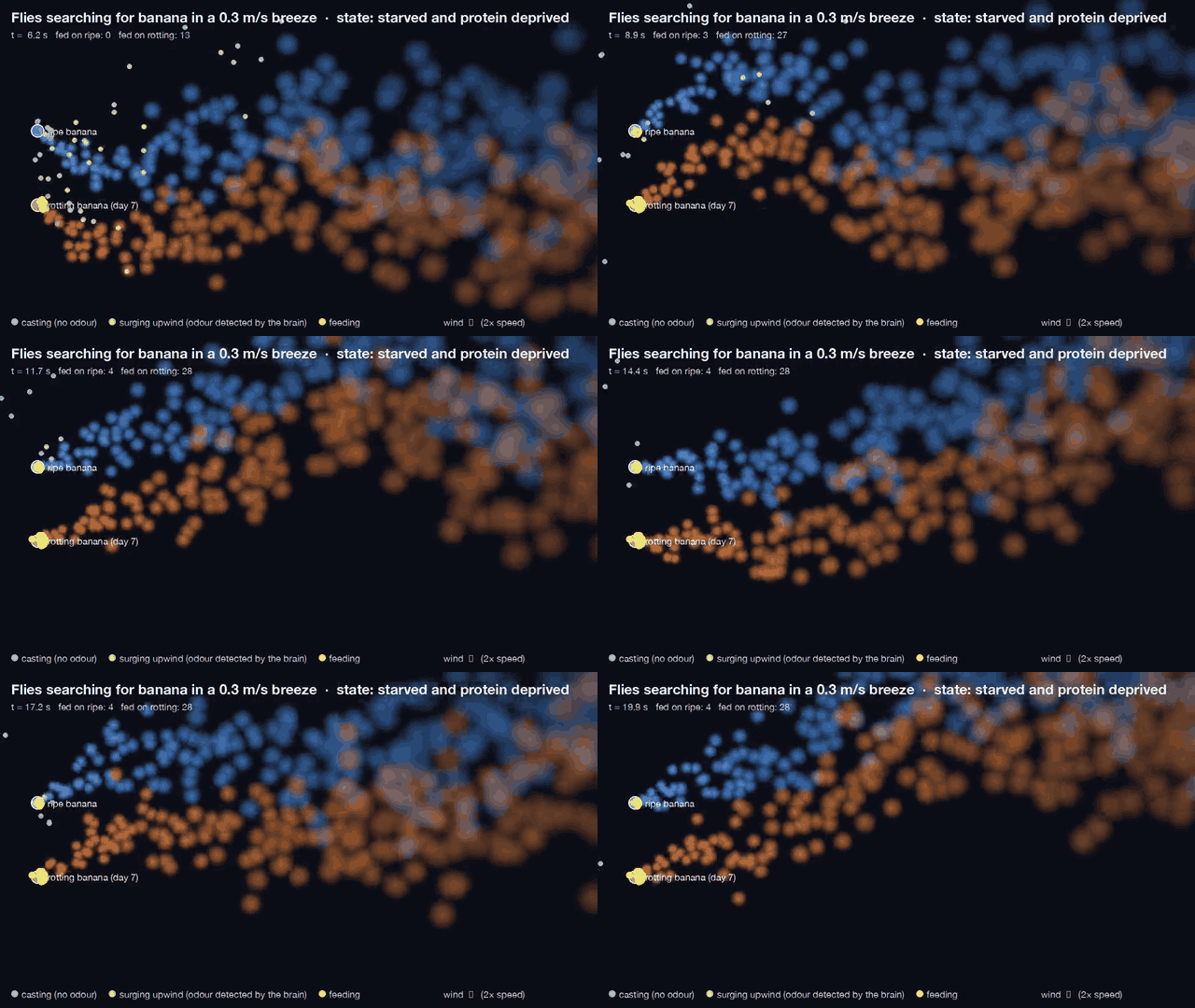
Flies deprived of food and protein search the odour plumes of a ripe (blue) and a rotting (orange) banana. Grey flies are casting; green flies surge upwind after their simulated brain detects the odour; yellow flies are feeding.
Fruit flies end up on rotting fruit. But is that because rotting fruit smells louder, because it tastes better, or because the fly's hunger, for energy or for protein, changes how it values both? Those explanations are usually tangled together. A simulation lets you pull them apart and switch each one on and off.
- 01 chemistryFruit14 days of ripening and yeast fermentation: sugars, ethanol, acetic acid, yeast, by-products, pH.
- 02 emissionVolatilesHow fast 11 odour molecules and CO₂ leave the fruit, from Henry's-law constants and temperature.
- 03 atmospherePlumeA turbulent, intermittent odour plume in a breeze: filaments, meander, dilution.
- 04 transductionReceptors59 olfactory receptors and 6 taste neuron classes driven by measured response data.
- 05 connectomeBrainThe complete male fly central nervous system as a spiking network, in four hunger states.
- 06 behaviourReactionSurge-and-cast flight, landing, and a feeding decision from the brain's taste response.
- Fermentation mainly makes fruit easier to detect.Yeast volatiles let the brain detect rotting banana at a tenth of the concentration, from about three times farther away.threshold 17.8 vs 1.78 s/m³ · range 2.4–6.0 m vs 7.7–19.2 m at 0.3 m/s
- The long-range pull of rotting fruit should be strongest in well-fed flies.Hunger sensitises the receptors ripe fruit uses. From 10 m, fed flies reached rotting fruit first; starved flies split evenly.fed 62–70% · starved 51%
- Up close, smell doesn't choose between fruits.Within a few metres both plumes are strong enough in every filament; the plume's path decides.first landings 50–53% on rotting across states, wind and temperature
- Rotting fruit tastes worse; the yeast on it tastes better.Less sugar, more acid and ethanol suppress sugar neurons. Surface yeast colonies more than compensate.rotting pulp 2–4× less acceptable to the brain
- What a fly eats depends on what it lacks.Protein-deprived flies feed mostly on yeasty fruit; sugar-starved flies are the least drawn to it.feeding on rotting fruit: protein-deprived 60–99% · sugar-starved 30–52%
The model is honest about where it breaks. The paper covers why, and what would fix it.
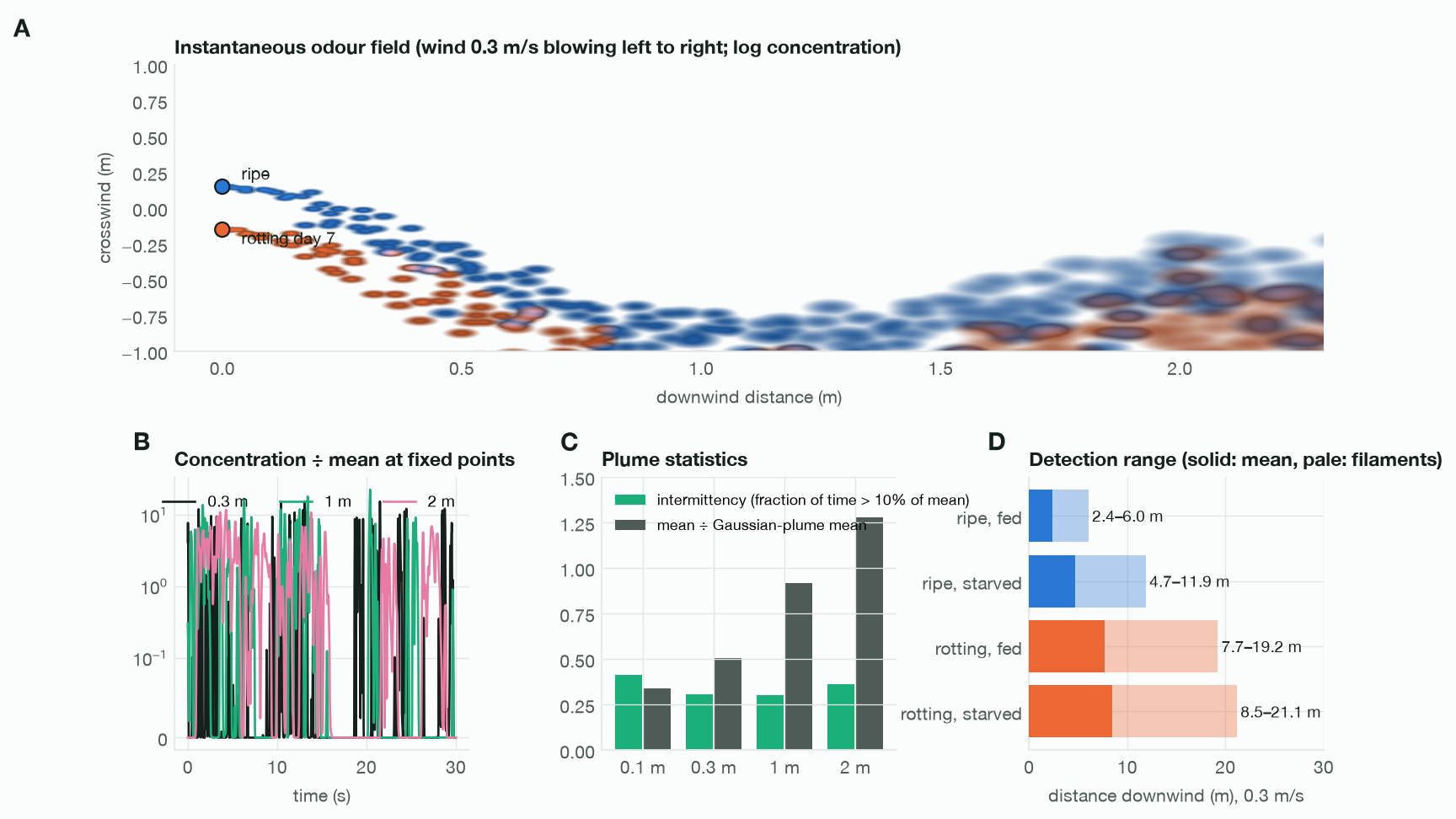
Atmosphere: odour arrives as brief filaments; rotting banana is detectable from about three times farther away.
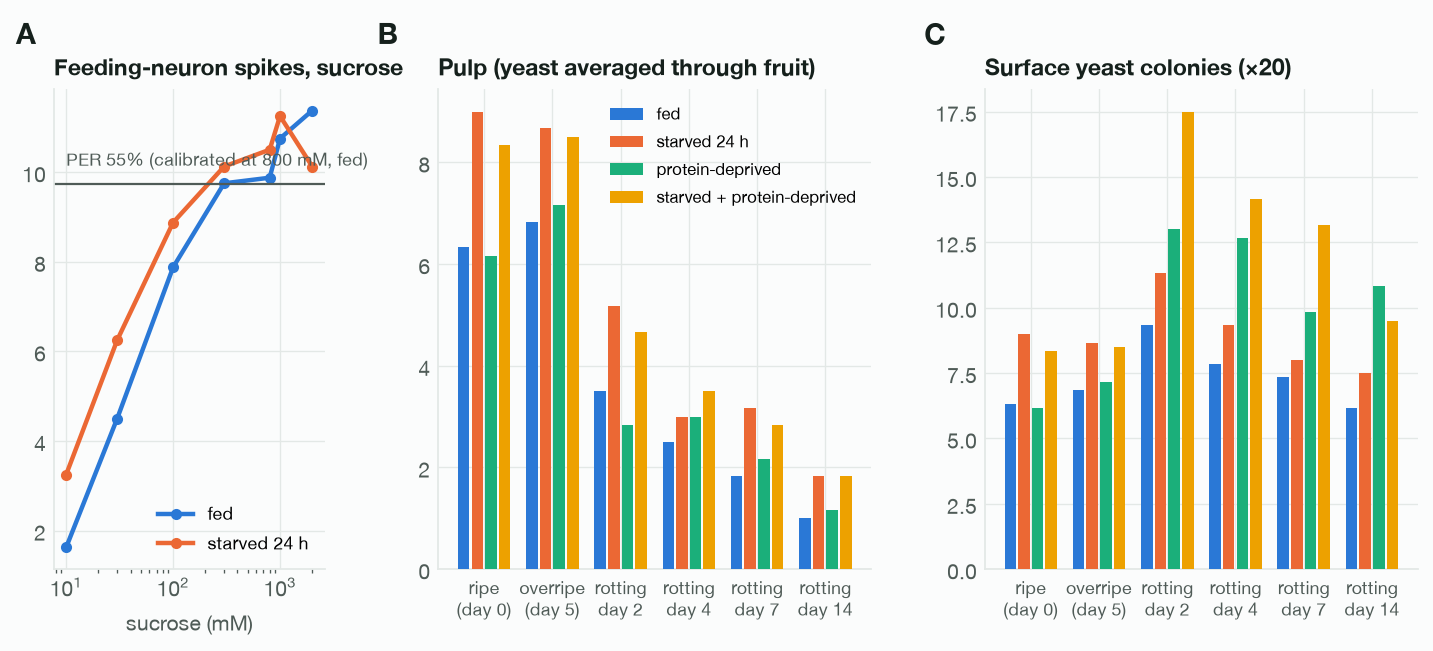
Taste: rotting pulp loses to ripe pulp, surface yeast wins, and hunger changes the margin.